Abstract
This paper critically reflects on a research project that aimed to understand a daily free food distribution taking place in the inner-city Parisian neighbourhood of La Chapelle. Ongoing since 2016, the Solidarity Breakfast presents itself as a legacy of the ‘acts of hospitality’ developed in response to the 2015 ‘migrant crisis’. It claims to ‘welcome’ migrants by offering them a meal in the park. This article analyses participatory drawing activities organised during the breakfast. It considers how internalist depictions of the micro-scale of the everyday make visible the relational space, whereas map-like drawings show a broader perspective in which power relations linked to the wider context of geopolitical and geo-economic entanglements are reiterated and reinscribed. By articulating these perspectives, the article examines how social practices and imaginaries are subsumed by neoliberal regimes. The article thus acknowledges the feminist insight that ‘the personal is political’, yet it argues that local social practices do not necessarily produce wider emancipatory impacts and that participatory research can be used to feed the routine rather than represent its political relevance. However hospitable the breakfast may be, its relational dimension may contribute to perpetuating rather than addressing injustice. The article concludes that participatory approaches can elicit unpredictable knowledge from the field, and hence they are key to broader conjunctural analysis provided that their critical scope is broad enough to question the conditions from which the research itself has emerged.
Key words: geopolitics, geoeconomics, participatory, feminist, methodology, mapping, hospitality, urban practices
1 – Introduction
Every morning along the esplanade at the Jardin d’Eole park in La Chapelle, Paris, a distribution of free food takes place as a gesture of welcome to migrants and refugees. Over the course of two hours, tables are set up and food is prepared and distributed, before everything disappears again, leaving no trace. Referred to as a ‘breakfast’, this ephemeral, everyday practice is claimed as the legacy of the improvised acts of hospitality that arose during the ‘so-called migrant or refugee crisis’ of 2015-16 (Bhagat & Soederberg, 2020, 193, 2019). While in the context of an increased influx of asylum seekers into the EU (Peters et al., 2023) the crisis was discursively produced through alarmist narratives (Krzyżanowski et al., 2018), austerity politics, and the hypervisibility of migrant illegality (De Genova, 2002), the breakfast has endured as an everyday choreography (Dikeç & Swyngedouw, 2017) of welcome. Ongoing since 2016, it is now integral to the rhythm of this inner-city neighbourhood, bringing together a group of residents, volunteers, and newly arrived migrants who collectively sustain a fragile but vital space of care (Ramakrishnan & Thieme, 2022).
This article reflects on the community-based doctoral research project which aimed to support the continuity of this action by conceptualizing it as a ‘heritage’ of hospitality. My long-term involvement both as a volunteer and a researcher at the breakfast shaped a collaborative, participatory methodology in which facilitating drawing among the attendees became a central practice for observing and extending the relational space being generated each morning. Building on non-representational theory (Thrift & Dewsbury, 2000, Thrift, 2008; Simpson, 2021, Anderson & Harrison), collective drawing activities were used not so much to depict things as to foster a spatial imaginary. Fully embedded in the materiality of the breakfast, participatory drawing was a way to negotiate proximity, elicit stories, and thereby trace the spatiality produced through everyday co-presence. Participatory creative activities enhanced the breakfast as a space where structurally oppressed people were, however slightly, able to perform agency, and produce new subject positions (Kesby, 2005, Henkel & Stirrat, 2001). This orientation responded to the Solidarity Breakfast collective’s attempt to achieve recognition for the breakfast as UNESCO Intangible Cultural Heritage—itself an attempt to ensure the visibility and temporal continuity of forms of everyday hospitality barely noticeable in the urban landscape.
Yet, while participatory drawing kept the research close to the emergent, unfinished character of this space, an important tension arose. As my analysis expanded beyond the intimate encounters of the breakfast, it became clear that these hopeful imaginaries did not sit outside broader dynamics shaping La Chapelle, a neighbourhood undergoing territorial reordering, regeneration, and heightened urban governance. Everyday acts of mutual welcome were performed within a context in which migrants are simultaneously vilified, managed and incorporated in the urban ecosystem in which they, quite literally, digest the leftovers sourced through the hospitality network, which thereby creates values for neoliberal ‘speculative urbanism’ (Sparke, 2014). Together with volunteers, and the resources collected daily, they shape a space, and a broader network, that re-territorializes global flows of goods and people.
This raised the question: how are participatory and creative research methodologies—even those grounded in feminist commitments to relationality, care, and co-production—connected with these wider dynamics? Such a question relates to one of the main challenges in participatory research (Kesby, 2007; Kesby et al, 2007), namely, how to ‘scale up’ the local, interpersonal spatiality shaped through participation with a view to producing a broader political impact (Pain et al, 2007). Yet, theorization of the social production of space (Lefebvre, 1991) demonstrates that scales are not fixed pre-assigned geographical structures but ‘ordering frameworks’ (Jonas, 2006, Taylor, 1982) produced through narratives emerging from action and struggle (Swyngedouw, 1997). Consequently, the question is not so much how to broaden the scope of local participation, but rather what narrative and spatial imaginary is produced through participatory research. More generally, such a question prompts concern as to the way in which participatory approaches rooted in grassroot feminist, antiracist, activist, social justice movements (Freire, [1970]1997; Fals-Borda, 1979; Cahill, 2011, Ritterbusch, 2019) are used today. Are they just ‘participatory arenas’ ‘from which to reflect on the world but not to change it’ (Kesby, 2005, 2059) or are they representational practices able to empower participants and address asymmetries of power?
The present collaborative research project and its participatory methodology were used ‘ontologically’ to make relational space through narratives of hospitality, space that actively contributed to producing a network that circulates and connects migrants, volunteers, recycled ‘free’ food, local businesses and global investments. Thus, the question concerns the way in which collaborative academic projects, feminist participatory research and creative methodologies risk being used to fuel an unjust system rather than challenging it. Such a question mirrors concerns that creative academic practices are not ‘innocent’ (Noxolo, 2025), even when emerging from situated engagements and commitments to social justice.
To address this issue, the paper draws on two main bodies of literature: on the one hand, feminist participatory methodologies (Askins, 2018; McDowell & Sharp, [1997] 2016; McDowell, 2016; Askins & Pain, 2011; Kindon et al, 2007; Mitchell, 2009) and, on the other, debates around geoeconomics, and ‘everyday geoeconomics’ (Szadziewski, 2021), as patterns of re-territorialization which materialize social and economic relations of only apparently de-territorialized neoliberal regimes (Sparke, 2018, 2013).
The resulting theoretical frame allows to rethink the research project more broadly and thereby reflect critically on its context, its use of participatory research and, consequently, its impact in terms of civic engagement (Barcus & Trudeau, 2018) and capacity to ‘construct empowering geographies’ (Pain et al, 2007). This will lead to the argument that, in line with criticism levelled at participatory research (Cooke & Kothari, 2001), collaborative methodologies need to make clearer distinctions between different ‘participants’, consider power dynamics within communities, and assess their participation in data analyses (Koopmann, 2024, Rappaport, 2020).
Nevertheless, rather than invalidating participatory methodologies and collaborative research projects in a discipline like geography that rightly values being ‘out in the world’ (Barcus & Trudeau, 2018), the article argues on the contrary that they provide a unique vantage point from which to observe conjunctural shifts (Peck, 2024; Grossberg, 2019). Research design does not in fact emerge outside the pressures of conjunctures. Through retrospective reflexivity, I show how the breakfast’s counter-hegemonic contestation of exclusionary bordering practices is entangled in geoeconomic agendas (Sparke, 2013) which seek to rescale and manage transnational flows of people and resources while maintaining existing hierarchies. This duality reflects the generative but ambivalent role that participatory practices play in shaping social realities.
Building on material produced through participatory drawing workshops, fieldnotes and sustained engagement with the breakfast collective, the article shows how a collaborative community-based (Shannon et al, 2021) project used participatory action research to support a spatial imaginary, a narrative and a practice of quotidian hospitality which was extended over time at the scale of everyday social reproduction but not as a wider struggle for social justice. Thus it advances debates on participatory and creative methodologies by highlighting that their performative ontologies require critical reflexivity and longitudinal research (Brickell et al, 2024).
The remainder of the paper proceeds by: outlining the collaborative project and its context; introducing the participatory approach, its epistemological implications, and other conceptual frames; examining drawing as an embodied and relational method; and analysing the conjunctural entanglements between daily hospitality and geoeconomic governance in La Chapelle.
2 – A collaborative project and its claim
The ongoing everyday food distribution providing actual sustenance lends ontological solidity to the messy ‘throwntogetherness’ (Massey, 2005, 149; Sparke & Mitchell, 2018; Darling, 2009) of the breakfast, but maintaining this daily improvisation is challenging without formal support or recognition is challenging. This concern underpinned an attempt by the breakfast collective to inscribe the practice in the UNESCO framework as Intangible Cultural Heritage performing and safeguarding ‘acts of hospitality’. The project, initially emerged from synergies between local activism and academia, led to a joint call for a collaborative doctorate to research La Chapelle’s hospitality and investigate its potential for heritage inscription[1].
The resulting research, summarised in this paper, explored the claim for continuity of ‘acts of hospitality’, seeking to signify welcome to migrants by providing homemade food even beyond the exceptional circumstances of the ‘migrant crisis’. This claim must be contextualised within the La Chapelle neighbourhood, characterised by major transport infrastructure (the Gare du Nord), poor housing conditions, urban renovation (Clerval, 2011) triggering ‘neocolonial urbanism’ (Kipfer, 2016), and ‘social mix policies’ (Kipfer, 2022). Suffering from its labelling as insecure, La Chapelle is undergoing extensive gentrification and regeneration, notably the long-term landscape improvement project around the Jardin d’Eole (Newman, 2015). Nonetheless, the neighbourhood also stands out for its vibrant social life, including informal organisations that have developed self-organised alternative spaces, relying on ‘coexistence’ and community-building with refugees (Stavinoha & Ramakrishnan, 2020).
Within this context La Chapelle’s breakfast is characterised by a practical, approach involving local households in a neighbourhood dynamic able to respond to the global immigration flows. Both in terms of material logistics and narratives, the breakfast emerged and became rooted in local everyday life. Although it physically disappears after its daily iteration, its presence persists through connections with the local library, community groups, as well as the shops and bakeries that ‘donate’ their unsold products. Despite its daily presence on Esplanade du Maroc, the Solidarity Breakfast collective is not openly supported by the local administration. The breakfast remains politically unaffiliated, but is keen to collaborate with NGOs such as Emmaüs, Action contre la Faim, France Terre d’Asile, and the Salvation Army. While narratives portray it as only ‘tolerated’ by the local administration, spatial dynamics around the site materialise this ambivalence through a mixture of cooperation and disregard for its spatial requirements.
Being an ‘informal’ collective, the Solidarity Breakfast did not have the necessary status to be a partner in the project. Therefore, the official non-academic partner was the PEROU association, of which some volunteers of the collective were part. Comprising intellectuals, artists and scholars – including one of Bruno Latour’s close associates, and consequently influenced by actor-network theory (Latour, 2005) – PEROU defines itself as an ‘action research laboratory’ acting as a ‘a tool at the service of the multitudes of undesirables’. Formerly active in Calais’ Jungle, and other contested metropolitan sites, PEROU frames its action as experimentation with ‘new urban tactics’ to ‘produce hospitality against the hostile city’[2].
The Solidarity Breakfast sought to ensure the continuity of its action as this helped making everyday acts of hospitality visible and politically significant. My research project therefore aimed to provide theoretical support for this posture with a particular focus on heritage and territory. It did so by following a feminist perspective (Pain & Staeheli, 2014; Pratt & Rosner, 2006; Mountz & Hyndman, 2006) that fully recognises the embeddedness of the domestic and the intimate across broader geographical scales (Blunt & Dowling, 2022). This purpose stemmed from finding that current geopolitical representations systematically overlook in-between-spaces where the opposition between territorial belonging and non-belonging is blurred. Against this, my research conceptualized La Chapelle’s quotidian, mundane hospitality as a form of feminist geopolitics (Dixon & Marston, 2011) bringing to light the embodied, everyday practices that make manifest the ‘place’ of traditionally disempowered people within all manner of ostensibly geopolitical landscapes (Dixon & Marston, 2011, 445). Rather than opposing the scale of the everyday welcome to the scale of national geopolitics, this implied a ‘flat ontology’ based on the generative self-organization of sites sustained by interactive practices made of actual material elements as well as virtual, but no less real, potentialities (Marston et al, 2005).
Such an understanding reinforced the breakfast’s geopolitical stance situating it within the tension of competing discourses about immigration. Against a backdrop of anti-immigration rhetoric translating into practices of ‘everyday bordering’ (Yuval-Davis et al, 2018) and, particularly so in La Chapelle, a spectacle of borders (De Genova, 2017) and of migrant illegality (De Genova, 2002, 2013), the breakfast offered a counter-narrative of hospitality, mutual recognition and support.
The breakfast collective’s motto, ‘we will be here as long as they are here’[3], appears to translate a moral commitment into duration. I argue that it can also be read as the expression of the interdependence between ‘us’ and ‘them’, and the space that residents and migrants create together; a space brought into being through the practice of everyday hospitality, one which deserved to be recognised, preserved and extended. I shall merely note in passing that, from a more critical perspective, such an interdependence inevitably brings to mind the link between accumulation and dispossession theorized as uneven development (Smith, 2008); this will be examined in further detail in the geoeconomics literature review at the end of the next section. Here I mention this simply to introduce the way in which this article compares two perspectives trying to work out how they relate to one another.
3 – A participatory approach
My epistemological approach to this research was shaped by my positionality as a volunteer, which preceded and informed my later role as an academic researcher. I refer to this positionality as an ‘insider perspective’, and argue that it founded my collaborative, performative, and participatory methodology, and hence my understanding of the practice. This positionality implied that rather than being a detached observer ‘of macro-centric perspectives without substantive concern for human agency’ (Yeung, 2023, 675), I was part of the field and contributed to its making. The collaborative project therefore took shape as participatory action research where ‘people who would be research subjects in more traditional approaches become producers of knowledge’ (Askins & Pain, 2011, 806). One implication is that my own role as a researcher emerged gradually with, and through, the research itself. A further implication inherent in participatory approaches is that the effects of the knowledge they produce is unpredictable and uncontrollable (Law, 2004). Whilst they tend to champion a rationale of empowerment and change-making (Koopman, 2024, Mitchell, 2006), their impact on multiple levels may be less straightforward.
As a community-based collaborative doctoral project, the research was aligned with a specific claim emerging from the collective formed around the breakfast. This claim concerned the temporal continuity of the practice, implied as the aim of the initial heritage project, and was an integral part of the research ethics and design. I devised the mixed participatory methods based in part on drawing activities, which I and other volunteers had previously facilitated, as a way to explore, enhance and fuel the hospitable space-time created through encounters (Valentine, 2008). Simultaneously, a researcher and a part of the field, I was both performing everyday hospitality and trying to conceptualize it. This implied the choice of drawing together ‘with’ participants instead of ‘mapping them’, that is representing them as a research object detached from the researcher. From this situated perspective where the researcher is ‘constitutive of social relations in place’ (Askins & Pain, 2011, 807; Dowler, 1999), I conceptualised La Chapelle’s ongoing breakfast as a feminist alter-geopolitical practice (Koopman, 2011) that, by ‘taking seriously everyday life’ (Smith, 2012, 1514) created new space by bringing people together and building alternative security (Koopman, 2011, 280) against hostile EU migration policies (Huysmans, 2006).
In critically reflecting on this collaborative research project, my concern is with the role played by participatory research in the production of the imaginary which characterises this space and this practice as welcoming. To tackle this, a brief review of the theoretical stakes of participatory research may be helpful. Participatory research stems from contexts of deep social and political engagement (Cahill et al, 2008; Rappaport, 2020; Mitchell, 2006), to the extent that, when abbreviated to PAR, the term ‘action’ is added in an attempt to resist its growing de-radicalization (Kindon et al, 2007). PAR is defined as an approach which promotes collaboration with participants and holds social and environmental change as a key objective, combining individual agency and structural transformation (Halvorsen, 2019). In theoretical terms, it entails the major epistemological shift of questioning ‘who’ is entitled to produce knowledge. Unlike mainstream traditions it recognizes not only that there is a plurality of knowledges beyond formal institutions, but also and especially that ‘specifically revealing wisdom’ is carried by oppressed and marginalised groups systematically excluded from knowledge production (Fine, 2010). Therefore, PAR constitutes a counter-hegemonic approach to knowledge production (Kindon et al, 2007, 9) committed to conducting research by ‘looking alongside’ rather than by ‘looking at’ research subjects (Askins, 2018). In creating ‘new spaces for engagement beyond the academy’ (Pain, 2004) PAR addresses the relations of power between margins and centre thus focusing on positionalities and the situated character of knowledge (Rose, 1997). PAR’s tendency to foreground local experiences is not unproblematic, however, as it can thereby lose perspective on how broader structural processes interact at the local scale (Pain, 2004, Kesby, 2007). Nonetheless, emphasis on the link between knowledge, people and space (Kindon et al, 2007) has enabled PAR to become a tool for strengthening local identities and struggles. PAR did however not ignore post-structuralist critiques suggesting, against the essentialization of social categories, that subjects are formed through discourses and practices (Foucault, 1977, 1991). Therefore, it emphasized the cultivation of alternative subjectivities and possibilities for being in the world (Cameron & Gibson, 2005).
Despite these commitments, a de-radicalised deployment of the ‘discourse of participation’ has been observed to serve a wide range of political agendas, notably in the context of development (Cooke & Kothari, 2001, Kothari, 2001) and planning (Mosse, 2001). Essentially, PAR’s original purpose as a tool for the representation of subaltern social groups is diverted as a technique to incorporate ‘people’s knowledge’ in top-down patronage (Mosse, 2001).
The very idea of a ‘tyranny’ of participation (Cooke & Kothari, 2001) suggests that it may be structurally and systemically predisposed to illegitimate and manipulative exercise of power. To conclude, it is worth noting that this ‘tyranny’ affects places as well as people. Whilst places, and geographies, can be re-imagined through participatory research (McIntyre, 2003), it is also true that PAR’s contribution to forming narratives and identities is being integrated within market-oriented strategies of place-branding (Ripoll Gonzalez & Gale, 2020).
Returning to La Chapelle’s breakfast, the participatory approach and ‘insider perspective’ as researcher-participant enabled me to gain an in-depth understanding of the daily mobilisation. Welcoming migrants through the daily offer of a free, homemade breakfast thus appeared as a feminist practice making relational space (Darling, 2009; Massey, 2005), shifting domestic versus urban spaces (Marston, 2000), and thereby challenging national geopolitics through a ‘quiet politics’ of practical action. This forged a spatial imaginary of the breakfast as a hub, a crossroads, where trajectories intersect and inscribe an extensive network. Acting as a ‘manifold’ (DeLanda, 2013), the hub emerges from an immanent and contingent practice recreated day after day as a combination of difference and repetition , supported by affective intensities, and triggered through a network of links and connections. In terms of scale, what emerges is the idea of a generative, flat ontology which extends organically through its own continuity.
Yet from another perspective it could also be seen that the hopeful spatial imaginary shaped through the practice was both the outcome and a driving force of global geopolitical (Hyndman, 2012; Mamadouh, 2012) and geo-economic (Sparke, 2007; Mallin et al., 2024; Mallin & Sidaway, 2023) dynamics. In this broader view, the ‘making’ of hospitable space and time (Dikeç et al., 2009; Dowler, 2013) and the ‘anti-geoeconomics at the intimate scale’ (Inverardi-Ferri, 2024, 3; Smith, 2012) promoted through participatory research appeared to ‘engineer’ territories through bodies (Smith, 2012, 1515) for inscription in a geo-economic project.
To reflect on the epistemological, methodological, and performative dimensions of the research as part of the dynamics underlying neoliberal ontologies, I rely on the analysis of spatial projections. These materialised through participatory methods based on drawing, intended to share, understand, and extend the relational space created during the breakfast. Using the breakfast tables as spaces where, in addition to food and stories, lines were drawn that evoked journeys as well as the present stasis, I sought to make visible and enhance the relational space-time brought into being every morning. Such a representation hypostatised the imaginary of a virtual space of hospitality which, contrary to the Westphalian container-space conception rooted in the territorially bounded sovereign state (Dell’Agnese, 2013), was ‘not yet’, ‘never completed’ (Dikeç, 2002, Derrida, J. & Dufourmantelle, 2000), and therefore open and extendable. Whilst Derridian hospitality supports the unfinished open nature of such a spatial imaginary, Deleuze inspires its immanent, form-generating, self-organising ‘site ontology’ as a ‘manifold’ that does not precede the interactive processes which assemble it ‘but emerges from the interactions of its human and non-human inhabitants’ (Marston et al, 2005; DeLanda, 2013).
Debates in geopolitics and geo-economics offer a frame for the critical scrutiny (Mallin et al., 2024) of hopeful discourses (Sparke, 2007), and through which to understand the interdependence between the spatial imaginary created through the breakfast’s hospitality and its emergent function in terms of urban economy. While I refer to other studies for a genealogy of these concepts (Slobodian, 2024; Mallin & Sidaway, 2023), for present purposes it is important to consider the idea of a ‘simultaneous interplay’ between geoeconomic and geopolitical logics (Mallin et al., 2024). Geoeconomics and geopolitics stand in a dialectical relationship (Sparke, 2007) where political power is required to protect market hegemony (Cowen & Smith, 2009). Attempts to understand this entanglement require conjunctural analyses (Sparke, 2024a) that can account for broad dialectical movements, resulting in competing discourses, divergent perspectives, and neoliberal forms of governance that reframe national sovereignty.
Far from mere abstractions, these dialectical entanglements take material forms as ‘processing zones, enterprise zones, innovation zones and free zones in which neoliberal freedoms are carved out from nation-states and embedded geoeconomically as exceptional sub-national spaces’ (Sparke, 2024b, 3, Slobodian, 2023). Such zones are ‘idealized as bringing geoeconomic peace and prosperity’ against geopolitical conflicts (Sparke, 2012, 289). In the context observed, the geopolitical moment manifests itself through a strengthening of borders that makes migrants illegal. Migrants’ high visibility in the urban space, and their alleged, and widely mediatized social, economic and cultural impact opens up competing discourses about immigration. Amongst these, narratives of hospitality claim that unwanted migrants can be transformed into ‘invited guests’. Yet, the very possibility of such an invitation depends on the exposure of subjects dispossessed and rejected by nationalist geopolitics. Incidentally, it is perhaps no coincidence that breakfast users are referred to as invités, that is ‘invitees’.
Thus, while it remains entangled with nationalist geopolitics, the claim for hospitality takes the form of a post-nationalist liberalisation whereby private citizens and resources are mobilized to offer welcome. Narratives of hospitality draw on the domestic dimension and multi-scalarity of home (Brickell, 2012) to relocate the experience of intimate hosting in the urban public arena (Boccagni & Giudici, 2022). Similarly to ‘humanitarian volunteering’ in Calais’ Jungle (Sandri, 2018), La Chapelle’s commitment to welcome relied on mostly unpoliticized, improvised volunteers bringing aid close to their homes. While this provides an alternative to the ‘humanitarian machine’ (Sandri, 2018), the affective character of these mobilisations as well as their informality and anti-institutional approach nevertheless contribute to neoliberal governance (Muehlebach, 2012). Discourses of hospitality thus link migrant exposure to the participatory ethos of volunteering thereby triggering post-national geoeconomic reterritorialization and liberalisation. Leaning on ideas of sustainability, welcoming transnational communities and creativity (Florida, 2002, 2014) this contributes to a speculative urbanism (Sparke, 2013, Goldman, 2010) that materializes slums alongside global city affluence thus highlighting the linkage of divergent spaces of accumulation and dispossession (Sparke, 2013, 302).
Based on this theoretical lens, and stepping away from the affectively intense situation of participatory drawing the space of the breakfast is revealed as part of a different and much broader panorama: a practice that appears to herald change by virtue of welcoming migrants is articulated with geoeconomic projections in view of new incorporations (Sparke, 2007). While the breakfast claims to represent a contestation of ‘everyday bordering’ (Yuval-Davis et al., 2018), its imaginary of improvised hospitality is mobilised to impose a particular fix on a crisis (Harvey, 2001, Jessop, 2006; Inverardi-Ferri, 2024), through its management of people and recycling of resources. It allows the materialization of uneven development (Smith, 2008) at the urban scale to be presented as a manifestation of hospitality.
Thus, in reflecting on the articulation between the internalist perspective and the broader geoeconomic view, I suggest that, far from being contradictory, they are in fact interdependent. To this end, I will show that while the act of performing and theorising hospitable co-constructed spaces of hope (Harvey, 2000; Thrift, 2004) fosters confidence in the possibility of wider and more positive transformation, it also actively contributes to transnational geo-economic dynamics (Mallin & Sidaway, 2024; Sparke, 2024) that perpetuate inequality. This insight has triggered deep critical reflection on participatory and creative research methodologies, raising questions about the ‘performative ontology’ (Thrift, 2012, 147; Kesby, 2007; Jessop, 2006; Harvey, 1996) they produce, and about its function within socio-economic dynamics. Again, this relates to the impact of participatory methodologies, suggesting that ongoing hospitable everyday encounters, and the spatial imaginaries they foster, do not necessarily address inequality (Barcus & Trudeau, 2018, Valentine, 2008). Instead, everyday rehearsals such as the breakfast can actually obscure the dynamics that pre-empt the social values being promoted.
These questions address Patricia Noxolo’s recent caution that creative endeavours are ‘not innocent’ and that academic projects are ‘generators of complicit creativity’ (Noxolo, 2025). I address her concerns by showing how participatory methodologies offer an in-depth understanding of the creativity that emerges from insecure positions (Noxolo, 2018) and thereby promote agencies and practices that fuel hope for change-making. This situated perspective nonetheless risks concealing the geoeconomic dynamics while contributing to their functioning. Yet, if this risk can hardly be avoided in the initial stage of research, deep involvement with the studied context and critical reflexivity ultimately reveal what was intended to remain out of focus.
This relates to Jamie Peck’s (2024) observation about the ‘aspirational’ and ‘largely retrospective’ character of conjunctural approaches. In the context of a neoliberal dialectic fed by contradictions, critical retrospective reflection and ‘longitudinal’ extensions of research temporalities (Brickell et al., 2024), should be an integral and distinctive aspect of conjunctural approaches. In other words, research design is not chosen in a vacuum but subject to the pressures of a given conjuncture. Therefore, retrospective critical reflection is crucial to ensuring that research is not limited by that initial conjuncture and to problematising the situated context from which it originated
4 – Drawing from within
This research took up the breakfast’s claim to continuity through the ‘insider perspective’ of a volunteer/participant with academic expertise. My commitment as a volunteer, participating in food distributions and facilitating related drawing activities at La Chapelle’s public library, had already lasted over a year before the project began. The practice was for me a form of activism translating feelings of solidarity into practice. Moreover, I was familiar with the local context and networks from a previous project on cultural heritage and migration.
My methodological approach was therefore grounded in already being part of the field as a volunteer developing research from the ground up to gain theoretical understanding. This, however, entails the ambiguity of being a participant in one’s own research. As a doctoral student, I was, on the one hand, in charge of my own research, yet, on the other, I was supervised both by the collective, and by the academic institution. These advisors regarded me as researcher in becoming but also as an ‘authentic’ participant (Baker, 2022) guaranteeing genuinely committed research, not lite ‘participatory bluffing’ (Ritterbusch, 2019). This raises complex issues – which I shall not go into here – regarding my legitimacy as a participant as well as a researcher. The participatory approach was nonetheless collaboratively designed especially with a view to understanding hospitality as a practice and with potential for recognition as intangible performative heritage (Tolia-Kelly et al., 2017; Waterton et al., 2017).
In adopting a participatory approach, the main problem was that of a collective which, insisting on its informal and non-exclusive nature, claimed to include people with very different positionalities. By insisting on the informality of the collective, the breakfast’s spokespeople wished to include ‘invitees’ in the effort to avoid their dehumanisation and reduction to the structurally defined category of ‘migrants’. Consequently, the task was that of constructing a hospitable space that would, if only temporarily but regularly, ‘restore’ equality through mutual recognition. However romanticised, building a cosmopolitan community with migrants was, indeed, a key element in the collective’s imaginary which claimed not to be just ‘filling empty stomachs’[4]. Therefore, it was keen on any form of participation, from practical tasks to playful and creative activities, with a particular focus on dancing, which was practiced frequently and successfully.
Participatory drawing was in line with this approach offering and, moreover, offered a means to engage language barriers creatively and as a way to gather traces, and project representations, of the space built and imagined together. This was appreciated also by ‘invitees’ in precarious conditions for whom participation, especially in creative activities, was a way to assert agency. Drawing offered a further possibility in this sense and was successful because, albeit with all the limitations associated with power differentials, people chose to participate for the pleasure of engaging freely in a creative activity. This is in line with a post-structuralist approach which regards PAR as a way to form spaces where participants can ‘shift and create new identities for themselves despite the seemingly hegemonic power of dominant discourses and governmental practices’ (Cahill, 2007a; Gibson, 2001, 641).
The notion of ‘contact zone’ as a ‘space of human interaction across power differences’ (Torre et al, 2008, 24-25) is useful to understand the potential and the limitations of this approach. As a temporary yet powerful breaking down of socio-spatial boundaries, participatory arenas enable meaningful encounters and empathy (Ritterbusch, 2019) thus building understanding and a sense of communality (Askins & Pain, 2011). In the discussion that follows on drawings created in the participatory sessions, these aspects emerge from the first two examples, whilst the limitations relating to differences of positionality, power and agency become apparent in the subsequent examples.
The participatory sessions took place in the outdoor breakfast space, where I experimented with drawing activities that had been developed at the local library. Initially, the main problem was interacting with ‘invitees’ while they were having breakfast, so I chose to start sketching on my own and let those who were interested come over. Visible and slow, drawing permits others to observe while remaining at a distance. Drawing itself, and in the first instance, involves a spatial relation to ‘be drawn’ (Causey, 2017), whereby proximity and distance are played out and negotiated. Moreover, my own mediocre drawing technique was far from intimidating, on the contrary, it encouraged people to have a go themselves.
The participatory dimension of drawing developed from the intimate dimension of my notebook to the broader scale of ‘workshops’ held on tables. The term ‘atelier‘ (workshop), which was frequently used within the breakfast to designate the practical collective activities on site, was also used to refer to the convivial drawing sessions. The negotiation of the space in my notebook, which was often borrowed by participants, was a way for me to learn more about my own (in)capacity to welcome others. My difficulty in sharing it led us to set up tables where paper, markers, and pencils were freely available. As the drawing gradually became more familiar within the breakfast, ‘workshops’ could begin directly at a table where people were free to join in and leave as they wished.
Consent, therefore, ‘was an ongoing and openly negotiable process’ (Hall, 2020, 246). Regarding regular participants in the breakfast’s activities, I was able to inform them about my research by sharing a written outline of its rationale. This served as basis for discussions held during meetings onsite before the formal start of ‘fieldwork’. In addition to asking for consent, I committed to respect privacy rights, not to disseminate images without permission and not to record conversations. Over the twenty-four-month duration of the ethnography, at least fifty consenting invitees and volunteer participants, were regularly involved in my research. However, a large proportion of participants were people passing through, taking part only once, or very sporadically, briefly, and/or discreetly. These people could not always be adequately informed about the research. Nevertheless, I always asked for consent regarding the possible use of the drawings, which many wished to offer as a way of reciprocating the hospitality. At times, this called into question the practice of anonymising participants. While I did everything to ensure anonymity, I realised that many people actually wanted to leave their signature. The end result of this work is a collection of about one hundred drawings, contextualised and embedded within my fieldnotes.
In line with ideas about hospitality as improvisation, workshops were only loosely scheduled. To take place, they needed acceptable weather conditions and favourable interpersonal interactions outside my control. While I aimed to share and gather as much information as possible, I had to rely on the contributions and responses of others, ‘invitees’ as well as volunteers. As the research progressed, I learned some techniques to facilitate the setting up of workshops; this included coordinating with other volunteers, involving participants who had taken part before, and setting up together. I tried to plan the drawing sessions for every week over the two-year duration of fieldwork. The outcomes were so variable that no two workshops were alike, but drawing became somehow part of the breakfast and it generated at least thirty collective ‘workshops’.
Workshops offered emotionally intense moments of connection and reflection. Conversational themes invariably led to the routes travelled, to feelings of being stuck or even ‘lost’. While paths out of the temporal ‘limbos’ (Mountz et al., 2002; Brun & Fábos, 2015) of migrant trajectories could hardly be suggested, the daily co-presence of the breakfast formed a space-time which, however ephemeral, provided a ground for encounters. Whilst for ‘invitees’ the sense of empowerment forged through participation was unlikely extend beyond the participatory arena (Kesby, 2005), the practice supported the development of alternative subject positions, thereby creating possibilities for personal transformations that can herald wider social change (Cahill, 2007a).
As an attempt to ‘scale up’ and thus deploy the resources of participation to empower agency and promote sociospatial change (Kersby, 2007, 2828), participatory drawing workshops also became part of the solidarity breakfast’s ‘zine’ project. This resulted in four issues of a self-published zine inspired by DIY counterculture aesthetics (French & Curd, 2022). The workshops were a creative highlight of this project which, besides drawings and dialogues, also provided a direct connection with the breakfast itself. The ‘zine’ sought to combine the different yet neighbouring perspectives of migrants, volunteers, shopkeepers, stakeholders, and local administration staff. However, while the first issues managed to maintain that plurality of voices, subsequent ones showed a clear predominance of local political agendas.
Ultimately, these methods allowed me to observe how the relational space created through everyday acts of hospitality unfolded through the links and stories that drawing brought to the surface. Firstly, the space of the page, both materially situated and abstract, allowed observation and recording of the spatial relations around it. Secondly, the practice of drawing revealed a multi-scalar web of intimate connections and broader dynamics, illustrating their mutual dependence. Thirdly, drawing showed the space of the breakfast through the eyes of those physically present. This introduced other spatialities and temporalities in relation to the ‘here’ and ‘now’.
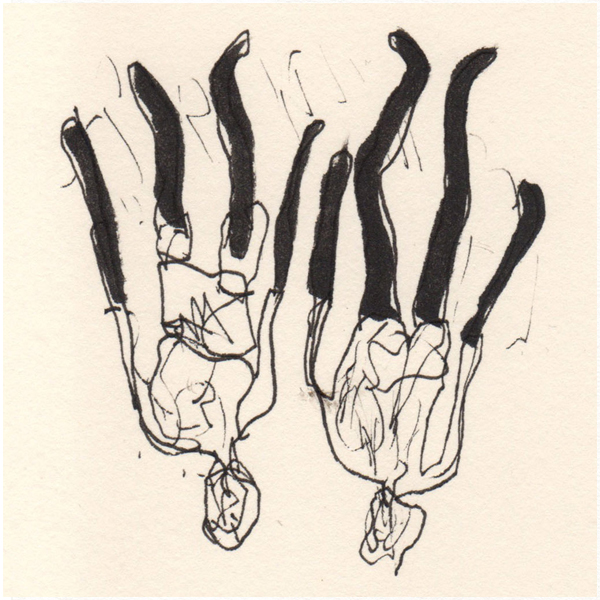
The following selection of drawings shows everyday interactions around the breakfast. The notebook page (figure 1) collects traces of a conversation facilitated by my attempt to sketch a goat, which attracted the attention of Participant 1, a refugee from Niger. This maps our wide-ranging conversation on the unstable borders of his country of origin, our names, the French terms that Participant 1 lacked in order to describe the goat, his aspiration of becoming a veterinarian, and possibility of reuniting with his wife (still in Niger) against the uncertainty of obtaining a visa, as his was currently ‘suspended’ (suspendu).
Fig. 1 – Author (2021) Notebook
The series of birds (figure 2) shows time spent together on the esplanade watching seagulls fly around, knowing that at that time, someone was always throwing them bread. Inspired by my attempts to sketch the seagulls flying over the breakfast tables, Participants 2 and 3 borrowed my notebook and started drawing. Participant 2 told me he would help me grasp the birds, but he did not try to depict a bird resembling those flying over the esplanade. Instead, he gave it a slightly exotic touch, stating that it is a green-winged bird. Participant 3’s bird, is perched on a bent branch that looks unstable. At the top, large and underlined, is his (or the bird’s?) country of origin (figure 2). Finally, Participant 4’s bird, drawn on one of the sheets of paper made available, resembles an airplane, and indeed is named De Gaulle, after Paris’s airport. Its aerodynamic shape and straight trajectory seem to cut through space, revealing aspirations of mobility that, the author stated, were denied to him. This strange taxonomy originates from a common vantage point situated within the breakfast. Through our gazes simultaneously inspired by the same contingencies it evokes a common space by summoning such different birds—each one present although rooted in a past time, distant space, and an uncertain future.
Fig. 2 – Author (2021), Seagulls; Participant 1 (2021), Green-winged Bird; Participant 2 (2021), Bird Perched.; Participant 3 (2021), De Gaulle. All drawings are used by permission of the authors.
Participatory drawing thus brought together a variety of affections and interactions whose convivial sharing, enhanced by the possibility of scribbling and doing collectively unpretentious drawings, revealed a shared immanence striving to turn it into a common spatial imaginary. Immersed in the ‘thick’ materiality of the lived and messy space (Askins & Pain, 2011; Ritterbusch, 2019) the drawing workshops expanded the hospitable space of the breakfast whilst remaining rooted in its social production.
Figure 3 illustrates a further step, however. Unlike the previous drawings, it makes visible how a rhetoric of participation was being constructed through the use of PAR. Here, drawings reflecting the messy ‘throwntogetherness’ (Massey, 2005; Sparke & Mitchell, 2018) are neatly arranged next to each other by myself with the intention to make visible the relational space created through the welcoming gathering. Likewise, and based a similar theoretical curation, the map, formed by the stain of coffee spilled by a gust of wind that knocked over a cup while we were conducting a workshop, is regarded as significant because it seems to integrate the human and even more-than-human trajectories that were relationally ‘making’ the space-time around those tables.
Yet whilst the messiness of the collective workshop is clearly evoked, its metaphorical use as spatial imaginary has not been developed in a participatory mode. However meaningful for changing geographical imaginations (Hyndman, 2012), this analysis is eminently theoretical and hard to be shared by the participants. This echoes criticism levelled at PAR concerning the analytical phase of participatory research processes rarely being participatory (Rappaport, 2020; Koopman, 2024; Cahill, 2007b). Nevertheless, reflecting on the meaning of this choice is revealing. It consists in fact in stating that the territory is also its own one-to-one scale map. This indicates that PAR is not working as a system of representation (Cooke & Kothari, 2001, Mosse, 2001) that it is supposed to be. The result is a rhetoric of participation that does not produce a representation. Instead, it is captivated into an allegedly flat ontology extended by perpetuating socio-spatial arenas for expression and participation. Consequently, no counter regimes of power and governance (Kersby, 2006; Cooke & Kothari, 2001) emerge from these participatory rehearsals.
Fig. 3 – Participants 5, 6, 7, 8 and author (2021), Drawing together and Coffee Map. Used by permission of the authors.
5 – Drawing to map
The collective ultimately abandoned the its application for formal UNESCO heritage inscription, which was intended to ensure the continuity of the breakfast, but the attachment to its daily occurrence proved strong. In its gradual rooting in everyday life, the breakfast needed to mobilise people and resources. Along with its daily organisation and distribution, the collective’s activities included collecting foodstuffs, using monetary donations to purchase materials, managing the stock, and ensuring that it would feed the turnout. Attendance was constantly monitored, reported and disseminated through the breakfast’s daily reports which were written up and posted on social media by volunteers who never fail to estimate the number of ‘invitees’ welcomed. It is therefore clear that the ‘invitees’ are also bodies, whose counts matter (Smith, 2012, 1516).
Like the previous drawings, the map reproduced here (figure 4) is the outcome of participatory work. It was made at the request of a newly arrived volunteer. Enthusiastic about the hospitality and the abundance of provisions, she saw potential to host and feed more people. She therefore wished to communicate with the people she encountered, especially around the Gare du Nord, who, she presumed, needed food and welcome. Following her indications and those of other volunteers, who also passed by places where people sleeping rough gathered for the night, we made a small map intended as a ‘flyer’ for distribution, with the function of inviting people to the breakfast.
Fig. 4 – Author (2021), The Flyer.
Contrary to the participatory drawing which strived to shape an imaginary of hospitable space, this map describes the actual urban space. What catches the eye, however, is the (obviously) imaginary teapot, indicating the breakfast, which pops up and stands out in the urban space as on digital maps where the attractions of the territory are highlighted. While retaining a makeshift style that signifies convivial, improvised hospitality, the flyer establishes the presence of the breakfast as if it were spatially permanent. This is crucial in terms of the relationship between the practice of hospitality and the space-time it produces. The breakfast takes place between 8:30 and 10:00am, after which it disappears, leaving almost no trace. By signalling its existence, this map extends the breakfast temporally beyond the practice. ‘Hospitality’ is thus represented through signifiers alluding to the willingness to make space collectively. At the same time, however, it is reified, and fetishized, as if it existed independently from those who make it. Thereby, the role of the ‘invitees’ is obscured; from co-producers they become passive consumers of recycled food. Instead, the hyper-active volunteers are highlighted, even to the point of initiating the movement of the marginalised and hungry population toward the breakfast.
Thus, the map reveals the internal power asymmetries that had been underplayed by enhancing participation. This mirrors critiques of PAR’s inadequate understanding of communities as ‘homogenous’ (Cooke & Kothari, 2001) and concealing internal power relations. Within the collective, however, power asymmetries were not just ignored but rather supposed to be addressed through the practice of co-constructing a common space. In this sense, while PAR aimed to expand interactions on an equal footing by ensuring their continuity and daily iteration, the practice, however many times it was repeated, could not extend beyond its immanence. As well as migrants, the power dynamics at play also affected me as a researcher/participant subject to the collective’s demands. Interestingly, while in the previous examples, I encouraged the participation of the ‘invitees’, and finally used it to support a theoretical analysis, here I, and my research, become tools in the hands of volunteer participants.
Alongside internal power differentials, the map sheds light on broader dynamics. The imaginary of the breakfast as a hub, a manifold and a collector, takes on a rather pragmatic connotation here. The map on the leaflet indicates where to find free food in the city. In doing so it gathers informal urban dwellers and directs them to the breakfast. Here, with the help of volunteers, out-of-date food, unsold bread, catering leftovers and donated goods are also brought together. The breakfast therefore appears as a hub within a growing network of informality which serves as ‘secondary processing of waste materials’ (Inverardi-Ferri, 2018). Structurally linked to city-ward global migration (Harvey, 2010), urban informality unrestrained by regulations notoriously adds to a city’s character, entrepreneurship and success (Roy, 2005, Lara-Hernandez, 2019).
A connection can thus be outlined between power differentials within the collective and the question of ‘scaling up’. Whilst the breakfast, and its participatory arenas, ensure continuity by re-enacting day after day the imaginary and practice of hospitality without ever giving rise to broader representations, the flyer/map demonstrates that another form of extension is not only possible, but already underway. Looking at the circulation of people, goods, informal labour and service exchanges, La Chapelle’s breakfast recalls the ‘free trade zones’ that literature on geoeconomics identifies as forms of reterritorialization of global dynamics (Sparke, 2018, 2013). As mentioned earlier, such zones reflect the tensions of uneven development. The breakfast collective attempted to join the two faces of uneven development under the banner of hospitality. Nonetheless, PAR, supposed to reinforce such a unity, finally reveals the power geometries that it had been concealing.
6 – Conclusion
This paper has reflected critically on a research project that emerged from a specific socio-spatial and political context which generated the questions and shaped the internalist perspective from which they were approached. The limitations become apparent once the project was completed, by comparing representations produced through participatory methods based on drawing activities. On the one hand, drawings that seek to project emerging geographical imaginations regarded as virtual but no less real (Marston et al, 2005) possibilities in the making, which therefore calls for the continuity of the practice on which it is based. On the other, a representation that looks like a map of the actual territory showing how the circulation instigated through the breakfast’s daily activity fits into the urban economy and governance. Whilst the first calls for the continuity of the action as a ‘quiet politics’ (Askins, 2015) that advances change for social justice, the second reveals how the ‘contact zone’ promoting inspiring encounters across difference ultimately contributes to incorporating subordinated groups into a geoeconomic system that perpetuates inequality.
This contradiction led to an examination of the participatory methodology whereby the two perspectives were produced, and questioned what kind of social space it creates. Following this line of inquiry, I examined literature on PAR and reflected on its purpose and limitations, which revealed PAR’s recurring inadequate understanding of power dynamics within communities engaging in participatory projects. Subsequently, I assessed the imaginary fostered through PAR through a theoretical lens that reveals how the embodied micro-politics of the everyday is both the driving force and the outcome of a dialectical interplay of geopolitics and geoeconomics.
The article thus builds on my work with participatory drawing explaining how it was used to document the hardly representable relational space (figure 1, 2) forged through the practice and enhanced through PAR; a spatial imaginary beyond mere immanence somewhat enforced through my theoretical interpretation (figure 3); and the participatory map (figure 4) representing the circulation of people and goods that other participants wished to increase. This permitted reflection on my positionality as researcher and participant, and on the power dynamics that it entailed. Whilst the drawings show how I encouraged, and somewhat used, work with participants for purposes that finally proved to be more theoretical than focused on political action, the map displays how more powerful participants were using participatory research to extend and intensify the reach of the network centred on the breakfast hub. The map thus displays an attempt to gather migrants and informal urban dwellers at the breakfast where they become consumer of excess accumulation thus revalorised as ‘hospitality’. In these terms, it appears as a spatial, and ‘moral’, fix, to a problem of re-distribution and social reproduction.
This leads to the issue of scaling up understood as the formation of social space beyond immanence. Echoing criticism already raised against PAR, the case of La Chapelle’s breakfast shows how participation can conceal inequalities within communities and thereby extract consensus and participation in line with neoliberal cosmopolitan, entrepreneurial urbanism. A ‘contact zone’ triggering encounters across difference can thereby scale up into a ‘free zone’. This may well create opportunities for empowerment and emergence of less oppressed subjectivities. However, at the same time it contributes to the continuity and reproduction at the macro-level of the inequalities downplayed ‘from within’. While these spatial formations appear to re-territorialize global dynamics, they also recall anti-globalization movements claiming: ‘No Globalization Without Representation’ (Sparke, 2013). If participatory approaches supposed to be a tool for the representation of the oppressed are diverted to do the opposite, this is a problem for democracy.
Nevertheless, this paper shows that, while their effectiveness as a straightforward system of representation cannot be taken for granted, participatory approaches can still be a valid research method. In fact, PAR here appears to provide interesting data for critical analysis by ultimately revealing what it was supposed to conceal. This relates to Noxolo’s observation on complicit creativity mentioned earlier. In a context of neoliberal ontologies, creativity is constitutive and, therefore, inherently complicit. However, a distinction can be introduced here. As the discussion around bird drawing (figure 2) showed, post-structuralist approaches utilising creative and participatory method assemblages can enact realities by binding together and emphasising some aspects while silencing others. Of course, this cannot be done ‘freely and at whim’, as the ‘hinterland of realities’ (Law, 2004, 143) cannot be ignored. This means that to overlook certain aspects, such realities must resonate with experience—and most importantly, trigger a transformative potential. Conversely, when it becomes clear that these realities are metaphors that conceal more than they reveal without bringing about change, the notion of complicity (Noxolo, 2025) comes into play.
Complicity is interestingly linked to participation and participatory approaches. Therefore, the latter appear to be valuable methodologies for ‘situated and granular explorations’ of emergent projects placed within evolving and contradictory capitalistic systems (Peck et al., 2025, 4). From one-sided, internalist perspectives, they may reveal connections to broader, unanticipated dynamics. At some point however, the issue of research unpredictability intersects with that of complicity. Situated participatory approaches, which yield new perspectives and unpredictable insights, cannot be forced to comply with the initial design unless they become complicit.
On this basis, I conclude that participatory methods can contribute to critical knowledge production provided they can go beyond the initial design and thus reflect on the power relation from which the research arose. Therefore long-term, longitudinal research (Brickell et al, 2024) is needed, with the reflexivity to question internal relations and relate them to the wider context. This provides a valuable contribution to conjunctural analysis by allowing ‘thick’ theorising from an internalist perspective (Peck, 2023) to emerge from a specific, situated context. From this perspective, the dialectic between everyday human experience and its capture within wider enterprises becomes evident. While this may fuel certain social realities, it also reveals the role, and thus the actual power and agency of participation. From this perspective, a broader, unpredictable understanding can arise which, however retrospective (Peck, 2024, Grossberg, 2019), represents a way to go beyond design and towards less complicit, and more emancipatory, forms of research.
Anderson, B. & Harrison, P (2010), The Promise of non-Representational Theories, in Taking place. Non-Representational Theories and Geography. Farnham, Surrey: Routledge.
Askins K, (2008). Renegotiations: towards a transformative geopolitics of fear and otherness. In Pain R, Smith S J (eds) Fear: Critical Geopolitics and Everyday Life. Ashgate, Aldershot, Hants. pp 235–248.
Askins, K., 2015. Being together: Everyday geographies and the quiet politics of belonging. ACME: An International Journal for Critical Geographies, 14(2), pp.470-478.
Askins, K and Pain, R, (2011). Contact zones: Participation, materiality, and the messiness of interaction. Environment and planning D: society and space, 29(5), pp.803-821.
Askins, K. (2018). Feminist geographies and participatory action research: co-producing narratives with people and place. GENDER, PLACE & CULTURE. Vol. 25, No. 9, 1277–1294 https://doi.org/10.1080/0966369X.2018.1503159
Baker, M., 2022. Becoming a researcher: Navigating messy researcher subjectivities. In The Messiness of Leisure Research (pp. 6-15). Routledge.
Barcus, H. R., & Trudeau, D. (2018). Introduction to Focus Section: Out in the World: Geography’s Complex Relationship with Civic Engagement. The Professional Geographer, 70(2), 270–276. https://doi-org.ezproxy.library.qmul.ac.uk/10.1080/00330124.2017.1365307
Bhagat, A., & Soederberg, S. (2019). Placing Refugees in Authoritarian Neoliberalism: Reflections from Berlin and Paris’. South Atlantic Quarterly, 118 (2): 421–438.
Bhagat, A. & Soederberg, S., (2020). The political economy of displacement governance: the case of refugees in the European Union. In A research agenda for critical political economy (pp. 195-207). Edward Elgar Publishing.
Blunt, A. & Dowling, R. (2022). Home. Key ideas in geography. London and New York: Routledge.
Boccagni, P., & Giudici, D. (2022). Entering into domestic hospitality for refugees: a critical inquiry through a multi-scalar view of home. Identities, 29(6), 787–806. https://doi-org.ezproxy.library.qmul.ac.uk/10.1080/1070289X.2021.1909359
Brickell, K., 2012. ‘Mapping’ and ‘doing’ critical geographies of home. Progress in human geography, 36(2), pp.225-244.
Brickell, K., Lawreniuk, S. and McCarthy, L., 2024. Qualitative longitudinal methodologies for crisis times: Against crisis exceptionalism and ‘helicopter’ research. Area, 56(1).
Brown, B. & Laurier, E. (2005), Maps and journeys: an ethnomethodological investigation. Cartographica. 40(3), 17–33. https://doi.org/10.3138/6QPX-0V10-24R0-0621
Brun, C. & Fábos, A. (2015). Making home in Limbos, Refuge Canada Journal on Refuge, 31(1), 5-17.
Cahill, C. (2007a). The Personal is Political: Developing new subjectivities through participatory action research. Gender, Place & Culture, 14(3), 267–292. https://doi-org.ezproxy.library.qmul.ac.uk/10.1080/09663690701324904
Cahill, C. (2007b). Doing Research with Young People: Participatory Research and the Rituals of Collective Work. Children’s Geographies, 5(3), 297–312. https://doi-org.ezproxy.library.qmul.ac.uk/10.1080/14733280701445895
Cahill, C., Rios‐Moore, I., & Threatts, T. (2008). Different eyes/open eyes: Community‐based participatory action research. In J. Cammarota & M. Fine (Eds.), Revolutionizing education: Youth participatory action research in motion. Routledge.
Cameron, J, Gibson, K (2005). Participatory Action Research in a poststructuralist vein . Geoforum, 36 ( 3 ): 315 – 331.
Causey, A. (2017). Drawn to see. Drawing as an ethnographic method. Toronto: University of Toronto Press.
Clerval, A. (2011). The spatial dynamics of gentrification in Paris: a synthesis map, Espace, Société Territoire, 553, 1-17
Cheikhali, S. (2025). Making space for healthcare delivery by drone in Ghana: A case study. Human Geography, https://doiorg.ezproxy.library.qmul.ac.uk/10.1177/19427786251347699
Cooke B, Kothari U (2001). ‘The case for participation as tyranny’, in Cooke, Kothari (eds) Participation: The New Tyranny? London: Zed Books, 1-15.
Cowen, D. & Smith, N. (2009), After Geopolitics? From the Geopolitical Social to Geo-economics. Antipode, 41: 22-48. https://doi.org/10.1111/j.1467-8330.2008.00654.x
DeLanda, M., 2013. Intensive science and virtual philosophy. Bloomsbury Publishing.
Dell’Agnese, E., (2013). The political challenge of relational territory. Spatial politics: essays for Doreen Massey, 115-132.
De Genova, N. (2002) ‘Migrant “illegality” and deportability in everyday life’, Annual Review of Anthropology, 31, 419-447. DOI: 10.1146/annurev.anthro.31.040402.085432
De Genova, N. (2013) ‘Spectacles of Migrant ‘illegality’: The Scene of Exclusion, the Obscene of Inclusion’, Ethnic and Racial Studies, 36(7), 1180–1198 DOI: 10.1080/01419870.2013.783710
De Genova, N. (2017) The Borders of ‘Europe’: Autonomy of Migration, Tactics of Bordering. Durham: Duke University Press Books.
Derrida, J. & Dufourmantelle, A. (trans. R. Bowlby) ([1996] 2000) Of hospitality. Stanford: Stanford University Press.
Darling, J. (2009) ‘Thinking Beyond Place: The Responsibilities of a Relational Spatial Politics’, Geography Compass, 3, 1938-1954.
Darling, J. (2011) Domopolitics, governmentality and the regulation of asylum Accommodation, Political Geography, 30(5), 263-271. https://doi.org/10.1016/j.polgeo.2011.04.011
Darling, J. (2013). Moral urbanism, asylum, and the politics of critique. Environment and Planning A, 45(8), 1785-1801.https://doi.org/10.1068/a45441
Derrida, J. & Dufourmantelle, A. (trans. R. Bowlby) ([1996] 2000) Of Hospitality. Stanford: Stanford University Press.
Dikeç, M. (2002) ‘Pera Peras Poros: Longings for Spaces of Hospitality’, Theory, Culture & Society, 19(1–2), pp. 227–247.
Dikeç, M & Swyngedouw, E., (2017). Theorising the politicising city. International Journal of Urban and Regional Research, 41(1), pp.1-18.
Dikeç, M, Clark, N, Barnett, C (2009). Extending Hospitality: Giving Space, Taking Time. In: Dikeç, Clark, Barnett (eds.), Extending Hospitality: Giving Space, Taking Time. Paragraph Special Issues, 32 (1). Edinburgh: Edinburgh University Press, pp. 1–14.
Dixon, D. P., & Marston, S. A. (2011). Introduction: feminist engagements with geopolitics. Gender, Place & Culture, 18(4), 445–453. https://doi-org.ezproxy.library.qmul.ac.uk/10.1080/0966369X.2011.583401
Dowler, L. (1999).’Participant Observation’. McDowell, Sharp, A Feminist Glossary of Human Geography. London: Routledge.
Dowler, L. (2013). Waging Hospitality: Feminist Geopolitics and Tourism in West Belfast Northern Ireland, Geopolitics, 18:4, 779-799, DOI: 10.1080/14650045.2013.811643
Fals-Borda, O (1979). Investigating the reality in order to transform it: The Colombian experience, Dialectical Anthropology, 4, 33–55.
Florida R. (2002). The rise of the creative class. New York, NY: Basic Books.
Florida, R. (2014). The Creative Class and Economic Development. Economic Development Quarterly, 28(3), 196-205.
Fine, M., 2010. An epilogue, of sorts. In Revolutionizing education (pp. 221-242). Routledge.
Foucault, M ([1975]1977). Discipline and Punish: The Birth of the Prison. London: Allen Lane.
Foucault, M ([1979] 1991). Governmentality. In Burchell, Gordon, Miller (Eds.), The Foucault effect: Studies in governmentality, 87–104. Chicago: University of Chicago Press.
Freire, P. ([1970]1997) Pedagogy of the Oppressed, Harmondsworth,Middlesex: Penguin Books.
French, J. & Curd, E., 2022. Zining as artful method: Facilitating zines as participatory action research within art museums. Action Research, 20(1), pp.77-95. https://doi-org.ezproxy.library.qmul.ac.uk/10.1177/14767503211037104
Gibson , K. (2001). Regional Subjection and Becoming. Environment and Planning D: Society and Space, 19: 639 – 667.
Gibson-Graham, J. K. (1994). “Stuffed If I Know!’: Reflections on Post-Modern Feminist Social Research. Gender, Place and Culture 1 (2): 205–24.
Gill, N., Riding, J., Kallio, K. P. & Bagelmann, J. (2022) ‘Geographies of Welcome: Engagements with ‘Ordinary’ Hospitality’, Hospitality & Society, 12, Special Issue Geographies of Welcome: Engagements with ‘Ordinary’ Hospitality, pp. 123-143. DOI: https://doi.org/10.1386/hosp_00053_2
Goldman, M., 2010. Speculative urbanism and the making of the next world city. International Journal of Urban and Regional Research, 35(3), pp.555-581
Hall, S.M., 2020. The personal is political: Feminist geographies of/in austerity. Geoforum, 110, pp.242-251
Halvorsen, S. (2019). Participatory action research. In Oxford annotated bibliographies (p. 22). https://www.oxfordbibliographies.com/view/document/obo‐9780199874002/obo‐9780199874002‐0210.xml
Haraway, D., 2013. Situated knowledges: The science question in feminism and the privilege of partial perspective 1. In Women, science, and technology (pp. 455-472). Routledge.
Harvey, D. (1996). From Space to Place and Back Again, in Justice, Nature and the Geography of Difference. Cambridge and Oxford: Blackwell, 291-325.
Harvey, D. (2000). Spaces of hope (Vol. 7). Univ of California Press.
Harvey, D., 2001. Globalization and the spatial fix. geographische revue: Zeitschrift für Literatur und Diskussion, 3(2), pp.23-30.
Harvey, D (2010). Social Justice and the City. University of Georgia Press,.
Henkel, H, Roderick Stirrat (2001). Participation as Spiritual Duty; Empowerment as Secular Subjection, in Cooke, Kothari (eds) Participation: The New Tyranny? London: Zed Books, 168–84.
Hyndman, J (2001). Towards a feminist geopolitics. Canadian Geographer , 45 ( 2 ): 210 – 22.
Hyndman, J. (2012). The Geopolitics of Migration and Mobility. Geopolitics, 17(2), 243–255. https://doi.org/10.1080/14650045.2011.569321
Huysmans, J., 2006. The politics of insecurity: Fear, migration and asylum in the EU. London: Routledge.
Inverardi-Ferri, C., (2024). An anti-geoeconomics of climate change. Environment and Planning A: Economy and Space, 1-5. https://doi.org/10.1177/0308518X241265589
Inverardi-Ferri C. (2018). The enclosure of “waste land”: Rethinking informality and dispossession. Trans Inst Br Geogr. 43: 230–244. https://doi.org/10.1111/tran.12217
Jonas, A.E., (2006). Pro scale: further reflections on the ‘scale debate’ in human geography. Transactions of the Institute of British Geographers, 399-406.
Jessop, B. (2006). Spatial fixes, temporal fixes and spatio‐temporal fixes. In Castree and Gregory (eds), David Harvey: A critical reader, New York: Wiley, pp.142-166.
Kesby M, (2005). Retheorising empowerment-through-participation as a performance in space:
beyond tyranny to transformation. Signs: A Journal of Women in Culture and Society 30
2037-2065
Kesby, M., (2007). Spatialising participatory approaches: the contribution of geography to a mature debate. Environment and planning A, 39(12), pp.2813-2831.
Kesby, M., Kindon, S. and Pain, R., (2007). Participatory action research: Making a difference to theory, practice and action. In Participatory action research approaches and methods (pp. 52-58). Routledge.
Kindon, S, Pain, R, Kesby, M (2007). Origins, approaches and methods. In Kindon, S, Pain, R, Kesby (eds) Participatory action research approaches and methods. Routledge.
Kindon, S, Pain, R, Kesby, M (2007) Participatory action research approaches and methods. Routledge.
Kesby, M., Kindon, S. and Pain, R. (2005) ‘Participatory’ Approaches and Diagramming Techniques, in R. Flowerdew and D. Martin (eds) Methods in Human Geography: A guide for students doing a research project, London: Pearson Prentice Hall: 144–66.
Kipfer, S. (2016) Neocolonial Urbanism? La Rénovation Urbaine in Paris. Antipode, 48: 603– 625. https://doi.org/10.1111/anti.12193
Kipfer, S. (2022) ‘Mixing it up : demolition and Counter – Revolution in Greater Paris’. Kipfer (ed.) Urban Revolutions : Urbanisation and ( Neo- ) Colonialism in Transatlantic Context. Boston : Brill , 200-239.
Koopman, S. (2011). Alter-geopolitics: Other securities are happening. Geoforum, 42(3), 274-284. https://doi.org/10.1016/j.geoforum.2011.01.007
Koopman, S. (2024). Will the real people’s geography please stand up? Community, public, and participatory geographies in conversation. Geography Compass, e12745. https://doi-org.ezproxy.library.qmul.ac.uk/10.1111/gec3.12745
Kothari, U (2001). ‘Power, Knowledge and social control in participatory development’, in Cooke, Kothari (eds) Participation: The New Tyranny? London: Zed Books
Krzyżanowski, M., Triandafyllidou, A., & Wodak, R. (2018). The Mediatization and the Politicization of the ‘Refugee Crisis’ in Europe. Journal of Immigrant & Refugee Studies, 16(1–2), 1–14. https://doi-org.ezproxy.library.qmul.ac.uk/10.1080/15562948.2017.1353189
Lara-Hernandez, J.A., Melis, A. and Lehmann, S. (2019). Temporary appropriation of public space as an emergence assemblage for the future urban landscape: The case of Mexico City. Future cities and Environment, 5(1).
Latour, B. (2005) Reassembling the Social: An Introduction to Actor-Network-Theory. Oxford: Oxford University Press
Law, J., 2004. After method: Mess in social science research. Routledge.
Lawreniuk, S. (2020). Intensifying political geographies of authoritarianism: Toward an anti-geopolitics of garment worker struggles in neoliberal Cambodia. Annals of the American Association of Geographers, 110(4),1174-1191. https://doi.org/10.1080/24694452.2019.1670040
Lefebvre, H (1991). The production of space. London: Blackwell.
Mallin, F. & Sidaway, J.D. (2024). Critical geo-economics: A genealogy of writing politics, economy and space. Trans Inst Br Geogr, 49(1). https://doi.org/10.1111/tran.12600
Mallin, F., Sidaway, J.D., Cheng, H. and Woon, C.Y., (2023). Introduction: Explanation, critique and critics of geo-economics. Environment and Planning A: Economy and Space, https://doi.org/10.1177/0308518X241280007
Mamadouh, V., (2012). The scaling of the ‘Invasion’: A geopolitics of immigration narratives in France and The Netherlands. Geopolitics, 17(2), 377-401. https://doi.org/10.1080/14650045.2011.578268
Marston, S. (2000). The Social Construction of Scale. Progress in Human Geography 24,2 (2000) pp. 219–242
Marston, S.A., Jones III, J.P. and Woodward, K., (2005). Human geography without scale. Transactions of the institute of British geographers, 30(4), pp.416-432.
Massey, D. (2005). For Space. London: Sage Publications.
McDowell, L., 2016. ‘Doing Gender: Feminism, Feminists and Research Methods in Human Geography’. In Space, gender, knowledge: Feminist readings (pp. 105-114). Routledge.
Feminist methods
McIntyre, A (2003). Through the eyes of women:photovoice and participatory research as
tools for reimagining place. Gender Place and Culture 10, 47-66
Mitchell, D. (2006). The people’s geography project: Popularizing radical geography. In T. Mizuuchi (Ed.), Critical and radical geographies of the social, the spatial and the political. Osaka City University.
Mosse, D (2001) ‘People’s knowledge’, participation and patronage: operations and representations in rural development’. In Cooke, Kothari (eds) Participation: The New Tyranny? London: Zed Books.
Mountz, A., Wright, R., Miyares, I. & Bailey, A. J. (2002) ‘Lives in limbo: Temporary Protected Status and Immigrant Identities’, Global Networks, 2(4), 335–356. https://doi.org/10.1111/1471-0374.00044
Mountz, A. & Hyndman, J. (2006) ‘Feminist Approaches to the Global Intimate’, Women’s Studies Quarterly, 34, (1/2), 446-463. https://www.jstor.org/stable/40004773
Muehlebach, A. (2012). The Moral Neoliberal: Welfare and Citizenship in Italy. Chicago: University of Chicago Press.
Newman, A. (2015). Landscape of Discontent: Urban Sustainability in Immigrant Paris. University of Minnesota Press.
Noxolo, P. (2025) Geographies of creativity/creative geographies. Transactions of the Institute of British Geographers, 50, doi.org/10.1111/tran.70008
Noxolo, P., 2018. Caribbean in/securities: An introduction. Small Axe: A Caribbean Journal of Criticism, 22(3), pp.37-46.
Pain, R (2004). Social geography: participatory research. Progress in human geography, 28(5), pp.652-663.
Pain, R, Kesby, M, Kindon, S (2007). Conclusion: the Space(s) and Scale(s) of participatory action. Constructing empowering geographies? In Participatory action research approaches and methods (pp. 52-58). Routledge.
Pain, R., & Staeheli, L. (2014). Introduction: Intimacy-geopolitics and violence. Area, 46(4), 344- 347. https://doi.org/10.1111/area.12138
Peck, J. (2023). Practicing conjunctural methodologies: Engaging Chinese capitalism. Dialogues in Human Geography, 14(3), 461-482. https://doi-org.ezproxy.library.qmul.ac.uk/10.1177/20438206231154346
Peck, J. (2024). Articulating conjunctural analysis. Dialogues in Human Geography 2024, Vol. 14(3) 504–508
Peck, J., Sparke, M., Anguelov, D. and Zhang, J., (2025). On the frontier of party-state capitalism: mapping the geopolitical economies of China’s Greater Bay Area. Geoforum, 164, https://doi.org/10.1016/j.geoforum.2025.104302.
Peters L, Engelen P-J, Cassimon D (2023). Explaining refugee flows. Understanding the 2015 European refugee crisis through a real options lens. PLoS ONE 18(4): e0284390. https://doi.org/10.1371/journal.pone.0284390
Pratt, G. & Rosner, V. (2006), The Global and the Intimate. Feminism in Our Time, New York: Columbia University Press.
Ramakrishnan, K. & Thieme, T. A. (2022). Peripheral humanitarianism: Ephemerality, experimentation, and effects of refugee provisioning in Paris. Environment and Planning D: Society and Space, 40(5), 763-785.DOI: 10.1177/02637758221124603
Rappaport, J (2020). Cowards don’t make history. Orlando Fals Borda and the origins of Participatory Action Research. Duke University Press.
Ripoll Gonzalez L, Gale F (2020), Combining participatory action research with sociological intervention to investigate participatory place branding. Qualitative Market Research: An International Journal, Vol. 23 No. 1 pp. 199–216, doi: https://doi.org/10.1108/QMR-02-2018-0028
Ritterbusch, A.E. (2019), Empathy at Knifepoint: The Dangers of Research and Lite Pedagogies for Social Justice Movements. Antipode, 51: 1296-1317. https://doi-org.ezproxy.library.qmul.ac.uk/10.1111/anti.12530
Rose, G (1997). Situating knowledges: Positionality, reflexivities and other tactics. Progress in Human Geography 21: 305–320.
Roy, A. (2005) Urban Informality: Toward an Epistemology of Planning, Journal of the American Planning Association, 71:2, 147-158, https://doi.org/10.1080/01944360508976689
Shannon, J., Hankins, K. B., Shelton, T., Bosse, A. J., Scott, D., Block, D., Fischer, H., Eaves, L. E., Jung, J.-K., Robinson, J., Solís, P., Pearsall, H., Rees, A., & Nicolas, A. (2021). Community geography: Toward a disciplinary framework. Progress in Human Geography, 45(5), 1147-1168.
Sandri, E. (2018). Volunteer Humanitarianism: Volunteers and Humanitarian Aid in the Jungle Refugee Camp of Calais. Journal of Ethnic and Migration Studies 44 (1): 65–80. doi:10.1080/1369183X.2017.1352467.
Simpson, P. (2021). Non-representational Theory. London and New York: Routledge.
Slobodian, Q. (2023) Crack-up capitalism: Market radicals and the dream of a world without democracy. New York, NY: Metropolitan Books.
Slobodian, Q., (2024). On the genealogy of geo-economics. Trans Inst Br Geogr, 49(1), p.e12653. https://doi.org/10.1111/tran.12653
Smith , N. (2008). Uneven Development: Nature, Capital and the Production of Space. Athens, GA: The University of Georgia Press.
Smith, S. (2012). Intimate geopolitics: Religion, marriage, and reproductive bodies in Leh, Ladakh. Annals of the Association of American Geographers, 102(6): 1511–1528. https://doi.org/10.1080/00045608.2012.660391
Sparke, M. (2007). Geopolitical Fears, Geoeconomic Hopes, and the Responsibilities of Geography. Annals of the Association of American Geographers, 97(2), 338–349. https://doi.org/10.1111/j.1467-8306.2007.00540.x
Sparke, M., 2013. Introducing globalization: Ties, tensions, and uneven integration. John Wiley & Sons.
Sparke, M. (2017). A map that roared and an original atlas: Canada, cartography, and the narration of nation. In Politics (pp. 481-514). Routledge.
Sparke, M. (2018). Globalizing capitalism and the dialectics of geopolitics and geoeconomics. Environment and Planning A: Economy and Space, 50(2), 484-489.
Sparke M & Mitchell K. (2018) ‘Lampedusa in Hamburg and the “Throwntogetherness” of Global City Citizenship’. Peck, Lave, Christophers (eds). Doreen Massey: Critical Dialogues. Economic Transformations. Agenda Publishing.
Sparke, M., (2024a). Defining geo-economics amid shifts in global hegemony: Critical geographies of new international conjunctures. Environment and Planning A: Economy and Space. https://doi.org/10.1177/0308518X241265293
Sparke, M. (2024b) Geoeconomics geohistoricised. Transactions of the Institute of British Geographers, 49, e12652. Available from: https://doi.org/10.1111/tran.12652
Stavinoha L. & Ramakrishnan K. (2020). Beyond humanitarian logics: Volunteer-refugee encounters in Chios and Paris. Humanity: An International Journal of Human Rights, Humanitarianism, and Development 11(2): 165–186. 10.1353/hum.2020.0018
Swyngedouw E (1997). Neither global nor local: ‘Glocalisation’ and the politics of scale in Cox K R ed Spaces of globalisation: reasserting the power of the local Guilford, New York 137– 66
Szadziewski, H., 2021. Everyday geoeconomics: The belt and road initiative in Oceania. Geographical Research, 59(3), pp.483-488.
Taylor P J (1982). A materialist framework for political geography. Transactions of the Institute of British Geographers NS 7 15–34
Thrift, N. & Dewsbury, J-D. (2000) ‘Dead Geographies – and how to make them live’, Environment and Planning D: Society and Space, 18, pp. 411-432.
Thrift, N., (2004). Knowing capitalism. London: Sage.
Thrift, N. (2008) Non-Representational Theory. Space, politics, affect. London, New York: Routledge.
Thrift, N., 2012. The insubstantial pageant: Producing an untoward land. cultural geographies, 19(2), pp.141-168.
Tolia-Kelly, D. (2017) ‘Race and Affect at the Museum. The Museum as a Theatre of Pain’. In D. P. Tolia-Kelly, E. Waterton & S. Watson (eds.), heritage, affect and emotion. Politics, practices and infrastructures. London: Routledge, pp. 33-46.
Torre M E, Fine M, Alexander N, Billups A B, Blanding Y, Genao E, Marboe E, Salah T and
Urdang K (2008). Participatory action research in the contact zone. In J Cammarota and
M Fine (eds) Revolutionizing Education: Youth Participatory Action Research in Motion (pp
23–44). New York: Routledge
Valentine G, (2008). Living with difference: reflections on geographies of encounter. Progress in
Human Geography 32, 323-337.
Waterton, E., Watson, S., Silverman, H. (2017) ‘An Introduction to Heritage in Action’. In Silverman, H., Waterton, E., Watson, S. (eds) Heritage in Action. Springer, Cham. https://doi.org/10.1007/978-3-319-42870-3_1
Yeung, H.W.C., 2023. Troubling economic geography: New directions in the post‐pandemic world. Transactions of the Institute of British Geographers, 48(4), pp.672-680.
Yuval-Davis, N., Wemyss, G. & Cassidy, K. (2018) ‘Everyday Bordering, Belonging and the Reorientation of British Immigration Legislation’, Sociology, 52(2), 228–244.
[1] LAHP/AHRC-funded Collaborative Doctoral Award at Queen Mary University London, and in collaboration with the association PEROU (The Pole for Exploration of Urban Resources) as non-academic partner.
[2] PEROU (Pole for the Exploration of Urban Resources, http://www.perou-paris.org/Manifeste.html )
[3] On sera là tant qu’ils seront là
[4] An expression often quoted within La Chapelle’s collective.